the fact that 15 year olds have more money than me because they lip synced to the weekend asking for coochie on musically makes me want to use my eyes as martini decorations
I don’t usually jump in with commentary these days, but I just saw this episode again for the first time in a lot of years, and I need to talk about this?
let me back up and talk about this episode in general. this is Early Days, obviously, this is Dean who still almost reverentially defends or is compelled to excuse their father, because he has yet to even begin to process a lot of their childhood and upbringing, and because a key component to he and Sam’s early relationship was the way they argued about John. John himself remains an enigma to us here, we’ve barely seen him, all we know is what Dean tells us and what Sam tells us, and their perspectives conflict. Dean is still meant to be the good soldier; Sam is still meant to be the rebellious son. (the early parallels to the Michael/Lucifer thing are so apparent in hindsight it’s a bit frightening, because they’re cosmic chess pieces, and they have no idea how cruel the game is). but this episode is also really difficult emotionally, and it plays with those emotions in a variety of ways.
this is at a point where Sam was ostensibly the surrogate, the way into the narrative, because he escaped this world, this life, and then circumstances wrenched him back into it, so the writing intends for us to be learning about the hunt through his rejoining his brother, we’re meant to be riding shotgun, too. there’s an argument to be made that the writing took turns switching that pov fairly early on, but that’s a whole other discussion, as is the fact that the archetypes established for Sam and Dean in the pilot are also deconstructed to a degree fairly early on (I think some of it even happens in the pilot itself, but it’s definitely happening by “Dead in the Water,” and by “Nightmare” the audience already knows – or should be recognizing – that the tropes we’re presented with and the things we’re sometimes told are often not what they seem, or are only scratching the surface of these two boys’ characterizations. but I digress).
anyway, Dean is multifaceted here (as he so often must be), dexterously slipping in and out of roles like he dons a costume, because so much of what he does is tempered by a performative fluidity (especially at this point in the story, with the dichotomous presence/absence of their father looming over him). Dean plays funny-bordering-inappropriate (reveling in dressing up like a priest, enjoying mini hot dogs), Dean plays offense and cynic, Dean has the wrong approach in taking his gun into the house (the wrong approach doesn’t mean it’s an invalid perspective, though, and it’s important to delineate that, and sometimes that nuance is lost when it definitely shouldn’t be), Dean protects and tends to a woman even though she doesn’t really deserve it because he’s not going to let her be murdered in cold blood, Dean has difficulty processing the evil humans do, Dean is terribly afraid for his brother (and of him, to a degree) and is doing his very best masking to cover it up – and he does a lot of this without verbally communicating it. this is fundamentally an episode for Sam with some mythology arc establishment, so his role is more concretely defined in its words.
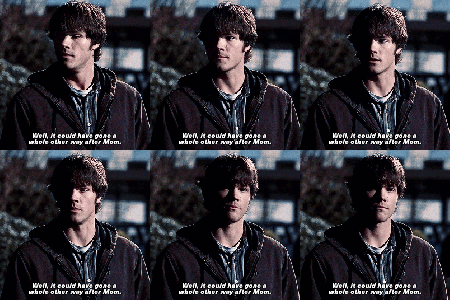
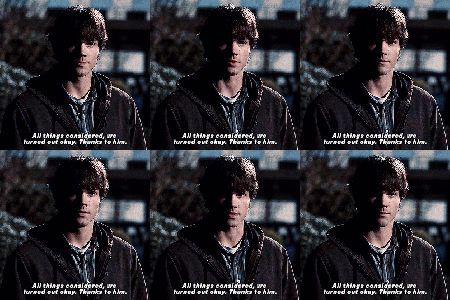
it’s the beginning, the first glimpse, of the “chosen” children, and it is terrifying and bleak. the “monster” isn’t a monster at all, but a victim, and Sam is the one with the empathetic (and telepathic) connection to him, as tends to happen when Sam sees himself reflected in someone, and that’s a necessity at this juncture. he listens to Max, describing being beaten by his dad and uncle, exposing the fresh bruise on his side, as Max asks if he knows what it’s like to have your father look at you with hate in his eyes, and Sam says no, and realizes it’s true. this is someone who lost their mother the same way they lost Mary, and then had no one to care for him, who was physically hurt with no one to step in and protect him, and it causes Sam to consider what he did have, and in that moment he comes away grateful, not resentful. Max is a dark mirror. the fight is against someone who doesn’t deserve to be harmed, who never deserved to be harmed and who was brutalized throughout his childhood. Max is grief and terror and trauma, and they wish they could save him, but ultimately, they can’t. it’s desolate and horrible and sad, and there was nothing they could do. (it’s also the first time we see Dean die bloody – the Shifter in “Skin,” and his sickness and near-death in “Faith” notwithstanding – and even though it’s in a vision, it’s startling.) ultimately, the Winchesters leave the scene, and head to the car, and have a conversation, and we get the exchange in this gifset.
Sam saying this is surprising, and you’d think after the fights they’ve had about their dad, Dean would be really happy about it. “Scarecrow” was only three episodes earlier, and there their altercation was so bad that they literally split up! Sam says, “We were lucky we had Dad,” and it might be the nicest thing anyone could ever say about John Winchester as a parent. Sam, who is already dealing with visions and telekinesis, who’s afraid of being a “freak,” then follows this up even further by saying, “We turned out okay.” he could respond by being wrecked by what just happened, but he’s grasping onto whatever he can find, and sure, he and Dean are nomadic outsiders who regularly face down horrors of the night, but they turned out “okay!” there’s an earnestness to it, but it’s tonally jarring. you’d think the Dean presented to us at this point should be thrilled, his response should be like, “I know, that’s what I’ve been trying to tell you! we have our dark spots, but we’re not cursed. we’re awesome!” but it isn’t. their positions are flipped, thrown off-kilter. Sam has been pushed to see what he did have, but Dean has been pushed the other way. suddenly he’s having to look at and truly examine how he was treated, and he’s not prepared for that at all yet, it’s threatening, it’s suffocating, even more than the worry of what’s happening to Sam. if he looks at it too closely and realizes how ruining it all was, he’s not going to be able to handle the other problems at hand. if he looks at it too closely, all those ugly inner demons like damaged self-worth are going to rear up and strike.
he’s surprised, and then almost bewildered, and then he makes this face that’s like…bordering on repulsion, honestly. look at his frown and that breath and the way he furrows his brow, and he immediately casts his eyes downward, which is clearly a deflection, and then he looks away from Sam altogether, back at the nightmare of a house, and they cast his face almost completely in shadow, the way the lighting is filmed obliterates him. Sam is mostly in the light (it’s a little more than half light, we can still make out his expression), but Dean is darkened and turned from us, and then he turns back and echoes, “All things considered” in an off tone, which doesn’t support what Sam was saying at all, it just parrots it. it is not an acknowledgment or an agreement. nothing on this earth will convince me that this wasn’t a conscious choice to subtextually tell us that he painfully doesn’t believe they turned out okay (despite anything he’s said to the contrary, which suddenly feels like sublimation), and that John abused Dean to some degree, in a different way than he did Sam (because whether he laid hands on them or not, there’s no way to justify his neglect and emotional abuse, which they both suffered and were damaged by in individual regards). we know John was often critical for various reasons, that he got angry over supposed infractions, that he raised his voice to them, that he treated them like he was their drill sergeant, but something more is happening here. and maybe it’s just that Sam got the chance to be a kid, which isn’t to disregard how awful his treatment was, Sam had Dean looking out for him, and Dean had no one, and was forced into a parental role as a child, something he should never have been. maybe it’s just that Sam didn’t have to worry about stealing/finding/preparing food, or stealing Christmas presents in an effort to make believe that your dad loves you, or not getting the last bowl of cereal, that Sam wasn’t the one constantly scared of not being protective enough, of being deficient and failing as a hunter and as a guardian (which we see even more clearly with Dean a few episodes later, in “Something Wicked”); maybe it’s simply a response to the fact that Sam, however briefly, got out, went to college, and had real friends, and knew what it was to sleep somewhere other than a trashy motel room, and there’s a part of Dean that envies that, because he never had a respite, and he’s ashamed that he wanted one. it could be all of those things, Dean is given a lot to express in a matter of nonverbal seconds (also a recurring theme – quick, deep flashes of emotion). but the choices that were made in the filming and the acting allude to something else underneath it.
the ominous quality remains to the last scene, where Dean is seemingly back to himself, composed, asserting they’re going to find and eliminate the yellow-eyed demon. Dean says none of this is Sam’s fault, and Sam expresses his fear that he could turn out like Max, and Dean then tells him that will never happen, because he had an advantage Max never had, and Sam is like, “Dad? Because he’s not here.” And Dean smiles and says, “No. Me. As long as I’m around, nothing bad is gonna happen to you,” and I swear this is still connected to the scene at the car, because yet again, Dean isn’t counting their father as an advantage, he’s putting that on himself instead – I’m here, and I won’t abandon you, nothing bad is going to happen. how many times did he have to be the buffer? how many times did he endure the bad things so that they wouldn’t touch Sam, especially when they were children? how many times did he reassure himself that he’d take whatever came, because he felt he had to be the protector? The moment passes, and he’s joking about using Sam’s psychic abilities in Vegas, and there’s a moment to breathe and hope things are okay, until it closes on the worry and anxiety in his face as he watches Sam get in the car, and that moment is so deliberately emotionally telegraphed that it’s unsettling (nothing is okay!), that it makes this scene prior to it stand out even more imho, because we’re getting cues and undertones to their interior lives that are narratively vital.
tl;dr the acting and directing/lighting take what’s in the script here and make it a shockingly brief and yet profound bit of character study
Devil May Cry 5 features a combat system where the music sounds cooler the better you play, so Journalist are gonna give it terribly reviews, accusing the game of being broken or unfinished, because they will not hear a single song.
People have been writing the same bullshit about deans deconstruction/reconstruction and learning and healing and valuing himself for like ten years.
Without suggesting how he’s supposed to do that under constant trauma and world threatening situations.
He’s just expected to magically llleeeeaaarrrn this time.
Please. How about imagine everyone you love has died in front of you. And it keeps happening. Now tell me you’d “learn” something about your self worth next time it happens.
Julius Caesar’s two most famous assassins, Brutus and Cassius, were the son and son-in-law, respectively, of a Roman noblewoman named Servilia. And Servilia and Caesar were fucking. Not just a one off thing, either. They were having an affair for literally decades. Everyone knew it. Why did everyone know? Well, one time Caesar and Cato, who was Servilia’s brother, were having a debate (catfight) in the Senate and a servant came in and passed Caesar a note. Cato jumps up, all indignant, and announces that Caesar is committing treason right in the middle of the Senate. See that treasonous note he just got handed? (Like I said, it was a catfight.) And Caesar is like, well Cato, here’s the treasonous note, how about we read it aloud to the Senate, huh? It was a love letter from Servilia. And that’s the story of how Caesar made Cato stand there and listen to the sexts Cato’s sister sent Caesar get read aloud in front of the whole Senate.
I’ve always been privately convinced (on no evidence whatsoever) that Brutus and Cassius killed Caesar because they were so fucking embarrassed that he was fucking their mother/mother-in-law.
Ej you can’t just drop all the goss and then say there’s more without sharing
Oh boy. I guess I can’t back out now, can I? Ok, let’s do this.
So Brutus’s great-grandfather was named Quintus Servilius Caepio and he was a completely shit person generally and got two entire armies massacred because he was an elitist shithead and wouldn’t work with someone he thought was low-class but anyway. He was on campaign and he captured this huge hoard of gold at this town called Tolosa and sent it back to the Roman treasury. But then the caravan carrying the gold was hijacked by bandits and it all disappeared. Surprise! Caepio hired the bandits himself and stole all the gold. People were (understandably) pissed.
I was actually wrong in the tags, it wasn’t Brutus’s grandfather, it was his great-uncle. Anyway, so Roman citizens were allowed to vote, but the other Italians, who made up like half of the Roman armies, weren’t technically citizens and couldn’t vote. Which annoyed them. So Brutus’s great-uncle, Marcus Livius Drusus, basically got all the Italians to swear an oath that they would do whatever he said if he could get them citizenship. And he almost managed it. Only historical example I can think of of someone trying to take over a country by expanding democracy. Drusus got assassinated pretty fucking fast.
And then there’s Cato, which, don’t get me fucking started. The dude tore out his own intestines with his bare hands because he hate Caesar so much. I am not fucking joking.
So Caesar fucked everything. Everything. This wasn’t a secret or anything. The dude (probably) fucked the King of Bithynia when he was like 20 and the king was like 80. He made a habit of seducing the wives of his political enemies just to be an asshole. When he held a triumphal march through Rome, his soldiers chanted “Home we bring the bald whore-monger, Romans lock you wives away.” Caesar was basically the embodiment of Big Dick Energy and he made sure everyone knew it.
So Clodia was like the tabloid sensation of her day. She had lots of affairs, maybe killed her husband, and then she got involved with this guy Caelius. Eventually they broke up, so Clodia got Caelius prosecuted for attempted murder. You know, like you do. I don’t have time to get into all the juicy details, but let’s just say it involved accusations of incest, gleeful slut-shaming, and Cicero’s wife being bizarrely jealous.
As for Antony and Curio, they were friends and Cicero at one point (after Curio was dead, if I remember correctly) accused Antony of having had an affair with Curio when they were young men. It’s not clear if this is true, because on the one hand, it’s totally believable (if Caesar was the embodiment of Big Dick Energy, Antony was the embodiment of just Big Dick. Like, he had a really big dick and he liked to show it off to everyone) but on the other hand, Cicero hated Antony and was talking all kinds of shit about him at the time, so who the fuck knows.
Anyway, please buy my Roman tabloid, because the next issue will discuss that time Clodius dressed up in drag to sneak into Caesar’s house and Caesar’s mother organized all the Roman noblewomen to hunt him down.
I couldn’t resist 😂
I love you
The Catones were all fucking extra. There are two lines: the snobby line and the crazy line, all coming from Cato the Elder.
Cato the Elder was born an eighty year old crank, was a pillar of stick up the goddamn ass, stingy as fuck, and spent an uncomfortable amount of time really concerned about the state of Scipio Aemilius’s ass and how he was using it and telling everyone allllll about it. He was also an asshole who had no sense of humor but I bet though he was hilarious.
Case in point: he married a patrician Licinia, had some kids, got old, she died, and so it goes. As he was well into his seventies/eighties, he took one of his slaves as a semi-regular mistress and his son and his wife–a patrician Aemilia–threw a shitfit from hell.
This was a mistake.
So he got rid of her and then completely unrelated went to visit his own former slave that he’d freed, who had an eighteen year old gorgeous daughter Salonia. So maybe it is related. He asked for her hand in marriage, married her, and brought her home so they could all live together because fuck you, Cato Junior. Luckily, he was eighty and after fathering a son on that poor girl who did not deserve this shit died, but only after assuring his son by her was allowed to enter the Senate and left him sufficient property to qualify because fuck you Cato Junior, this joke never gets old.
As you can imagine, the Catones Licinianii and the Catones Salonianii (did I get the spelling right?) really didn’t get along.
Cato ‘My Intestines Hate You Caesar, Ask Them” is descended from that second marriage. Then again, Intestines!Cato married Caesar’s step-niece–really–divorced her to marry her to an elderly friend of his, Hortensius–really–then remarried her immediately after Hortensius died. No. Really. Really.
Elderly wealthy friend Hortensius.
Elderly wealthy friend Hortensius Orator who was father of Hortensia.
You want to know Hortensia.
She was the widow of Caepio Junior (aka Servilia’s brother, yeah), which is important here because as she was a widow and of age, she controlled her own fortune, and women in Rome did not pay taxes on their personal fortune. Keeping in mind that women weren’t allowed to stand for office, make war, decide policy, and while children were chattels of their fathers or male guardian and while married were chattel of their husbands, that’s fair.
During the trimvirate of Octavius, Mark Antony, and Lepidus, they decided to tax the women of Rome to pay for their war against Caesar’s assassins.
Hortensia wasn’t pleased.
She then led a large group of women into the Forum Romanum, climbed up on the rostra, and threw the fuck down; you can read about what she said, bthough the exact speech isn’t around–yet–but the short version was fuck taxation without representation.
The triumvirs tried to make her and the other women leave the rostra; that so didn’t work. So they backed down.









 Kelli's Tumblr Backup